Intermech Sealing Solutions (Pty) Ltd - Graftec Metal Gaskets
The selection of gaskets has become more critical due to a number of factors which we will outline for you below.
Specification of the industrial problem
- Pipes and joints are now included in the pressure vessel codes
- Tighter rules for emission control
- Aggressive effort to lower costs by reducing product loss and increasing margins of safety
- The international demand for standards for eliminating asbestos gaskets
Objectives
Bearing in mind rising standards of emission control and restrictions on the use of gaskets containing asbestos, Intermech's objective is a systematic and optimized development of a better sealing system for bolted gasket flanges.
Goals
Our goal is simply to help our customers in understanding and solving, or preventing, field problems. Our search for something better led us to an impressive new gasket called the Graftec. This gasket is designed to provide superior performance over other gaskets.
Expected Achievements
Save money and increase margins of safety by:
- Better resistance against both chemical attack and high temperatures
- Reducing product loss through leakage
- Eliminating monitoring due to excessive fugitive emission levels
- Fewer industrial accidents caused by sudden gasket failure
- Preventing costs associated with production loss through plant shutdown and environmental clean-up costs
Graftec is proving to be the solution for controlling emissions
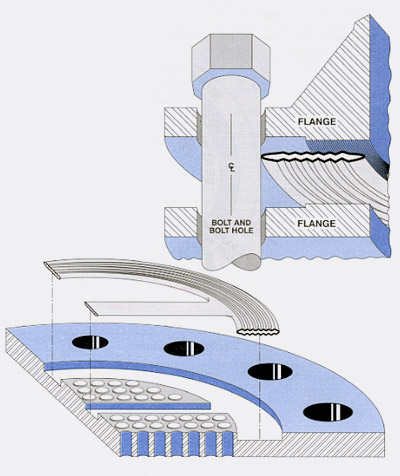
Exclusive Design Features
Encapsulated with flexible graphite
- Graphite is resistant in high temperatures to 850° F (450°C) in hot air, 1300°F (700°C) in steam environment. In reducing environments which are almost totally oxygen exclusive, such as nitrogen or carbon dioxide, the threshold is about 1650°F (900°C). In the absence of oxygen, 5432°F (3000°C)
- Resistant to low temperature of -328°F (200°C)
- Resistant to fluids with pH range of 0-14 (with a few exceptions)
- Inherently resilient
- Rapid heat transfer
- Excellent aging characteristics
- Readily fits small voids
- No binders-eliminates potential fluid contamination from binder residue
- Chemically bonded with polyester layer in a proprietary process that assures that the graphite will adapt to ultra-fine surface irregularities
- Different thickness of graphite are available for a wide range of applications
Concentric corrugated metal core
- Minimizes extrusions
- Pushes graphite into leakpaths
- Reduces gasket damage in handling and installation
- Extra strength, particularly in narrow cross section
- Increased recovery to handle bolt relaxation caused by Thermal Cycling
- Vibration
- Cavitation
- Limited Water Hammer
- Greatly increases sealability under low bolt loads
- Different Metals available to match flange metallurgy, temperature or chemical resistance
General
This gasket may be substituted for compressed asbestos or spiral wound gaskets in raised face weld neck or slip-on ASME/ANSI B16.5 class 150,300 & 600 carbon or alloy steel piping joints. Joints with these gaskets may be assembled with normal plant care.
Piping specifications for Graftec gaskets
Physical and Material Characteristics
- Corrugated metal encapsulated with chemically bonded flexible graphite.
- Nominal thickness: 1/16 inch.
- Graphite layers: 2 layers, each flexible graphite nominal .020 inch thick.
- Metal inset: Nominal .024 inch thick austinetic stainless steel with corrugations. Other types of metal are available.
- Gasket Dimensions: manufactured to all Internationally Accepted Standards and can accomodate special sizes or configurations.
Joint Assembly Characteristics
Gasket shall achieve tightness and be suitable for joint assembly using the same manual procedures, skills, care and tools as is appropriate for compressed asbestos sheet gaskets. Bolt load control such as torque settings is optional. Torque wrench not required.
Fire Resistance: Simulated Tightness Test (FITT)
- M&P Sealing Company, certifies the result of two tests, conducted in accordance with the Pressure Vessel Research Council FITT procedure 1.3 (Ref.1) on NPS 4 test gaskets exposed to a 20 minute heat-up plus 15 minute soak @ 1200°F, and the following:
- Required post exposure Minimum Tightness: Tpmin > 32 (Helium)
- Typical post exposure Minimum Tightness: Tpmin = 2000 (Helium)
- Required post exposure Minimum Tightness: Tpmin > 32 (Helium)
Room Temperature Tightness (Helium Media ROTT)
M&P Sealing Company certifies the result of two or more tests on 4 7/8" ID by 5 7/8" OD gaskets, conducted in accordance with the Pressure Vessel Research Council developed Room Temperature Tightness Test (ROTT) [Ref.2] procedure and the following:
| Requirement | Gb | a | Gs | S100 | S1,000 (1.2) |
| Maximum: | 1,300 | 0.273 | 9 | 3,180 | 5,630 |
| Typical: | 922 | 0.248 | 5 | 2,889 | 5,114 |
Notes
(1) The constants Gb, a and Gs shall be determined by the ROT test procedure of Ref [2]
(2) S100 and S1000 are stresses (psi) respectively representing the values Gb(100)ª Gb(1000)ª.
Crush Qualification Test
M&P Sealing Company certifies the results of a crush test on the Graftec Gasket that indicates the tightness parameter, Tp: and the gasket deflection, Dg (in.) with a gasket stress, Sg (psi) up to 40,000psi and internal pressure of 800psi (Helium). The test demonstrates adequate resistance to crushing by excessive bolt load.